.svg)
.svg)





.webp)





.webp)


.webp)


.webp)


.webp)
.webp)


No results found for your search
View all car rentals
Renting a car from Dubai to Oman is possible but comes with strict rules, detailed documentation requirements, mandatory insurance, and specific border procedures that you must follow to avoid fines, denial of entry, or rental contract issues.
Many travellers undertake this route every year to explore Oman’s mountains, deserts, and coastal cities, but it is important to prepare in advance with all required paperwork, permissions, and understanding of costs and regulations. Regional authorities have tightened enforcement in recent years to ensure safety and compliance.
This guide explains each step you need to take for a successful cross‑border trip from Dubai to Oman in a rental car, from checking permissions to understanding the border process.
Yes, you can take a rental car from Dubai into Oman, but only if the rental company explicitly permits cross‑border travel and you have all necessary documents and insurance.
Not all rental companies allow this, and policies can vary by branch and by vehicle type. Many major Dubai rental companies will accommodate Oman travel when asked in advance and when the necessary insurance and NOC are added to the contract.
Permission must be obtained before you pick up the car or at least well before you reach the border. Without this approval in writing, border officials will not let you take the car into Oman.
Policies can vary by company, and some restrict cross‑border travel for certain categories of cars (e.g., luxury or new vehicles) due to insurance risk.
To legally drive a rental car from Dubai to Oman, you must carry several specific documents that prove your identity, driving permission, and the vehicle’s insurance status.
You must have a valid passport with at least six months of validity left from your travel date. Border officials both at the UAE exit and Oman entry check passports carefully.
A passport is the primary identity and travel permit document used for immigration and customs checks. Without it, entry into Oman is not possible.
For most nationalities, Oman offers visa‑on‑arrival for short stays. For UAE residents, presenting your passport and Emirates ID usually triggers an automatic visa issuance at the Oman border, often valid for 14 days upon arrival and subject to a small fee paid at the checkpoint.
This visa can sometimes be extended or converted into a longer eVisa if applied for ahead of crossing. If you are not eligible for visa‑on‑arrival, you must obtain an eVisa before departure.
If you are a UAE resident, your Emirates ID is usually required alongside your passport to prove residency status. GCC nationals generally receive visa‑free entry for short visits. These procedures are standard at most Oman–UAE crossings.
You must carry a valid UAE driving license to operate the car legally. If your home country license is in English or in a language accepted by both UAE and Omani authorities, you can use it, but an International Driving Permit is recommended if your license is in another language or if you will also present the original license.
Oman recognizes GCC country licenses directly, and UAE licenses are widely accepted without an IDP.
A No Objection Certificate is essential when you drive a rental car across borders. This document is issued by the rental company on company letterhead, stating that they allow you, to take their vehicle to Oman.
The NOC often includes chassis number, plate number, rental dates, and permitted destinations. Border officials will ask to see this certificate. Without it, the border entry can be denied.
You must carry the original vehicle registration card (Mulkiya) for the rental car. This proves that the vehicle is legally registered in the UAE and belongs to (or is leased by) the rental company.
Border officials check the registration card to match the vehicle identity against the NOC and insurance documents. Without the original Mulkiya, border entry will be refused.
Standard UAE insurance does not cover driving in Oman. Oman requires vehicles to have insurance that is valid inside Oman, commonly referred to as the “Orange Card.”
The Orange Card is proof of at least third‑party liability coverage in Oman. Without this insurance, you will not be permitted to enter with the car.
You can obtain the Orange Card in one of three ways:
Temporary Orange Card insurance at the border typically covers basic third‑party liability and costs in the range of around AED 100–150 for five days, with prices increasing for longer durations.
Third‑party insurance means your own vehicle damage may not be covered, so this is only advisable for short trips or if you secure full cover ahead of time.
The cost of renting a car from Dubai to Oman includes several components beyond the base rental rate. Planning the budget accurately ensures your trip is comfortable and free of surprises.
The daily rental fee varies widely depending on the vehicle type, economy cars are cheapest, while SUVs and luxury vehicles cost more. Cross‑border permissions or NOC charges often incur an additional fee charged by the rental company.
Insurance for Oman travel, the Orange Card, is another cost. If arranged through the rental company, this fee is normally added to your rental bill. If you purchase it at the border, it will be charged directly at the checkpoint.
You should also budget for fuel costs. The distance from Dubai to Muscat (Oman’s capital) is about 450–500 km one‑way. Fuel prices in Oman are generally lower than in the UAE, but the volume of fuel needed for a return trip can still be a significant expense.
Visa and customs fees are also part of the total cost. UAE exit fees are charged per person at the UAE border, and Oman may charge a nominal visa fee, often around 5 Omani Rials (approximately AED 45–50), for tourists entering the country. These fees are usually payable at the border during the immigration process.
Finally, if you plan to drive popular tourist routes or stay multiple days, consider the costs of accommodation, food, and internal travel within Oman.
Understanding the border crossing sequence helps you prepare and avoid delays. Although procedures are straightforward, missing a document can result in denial of entry.
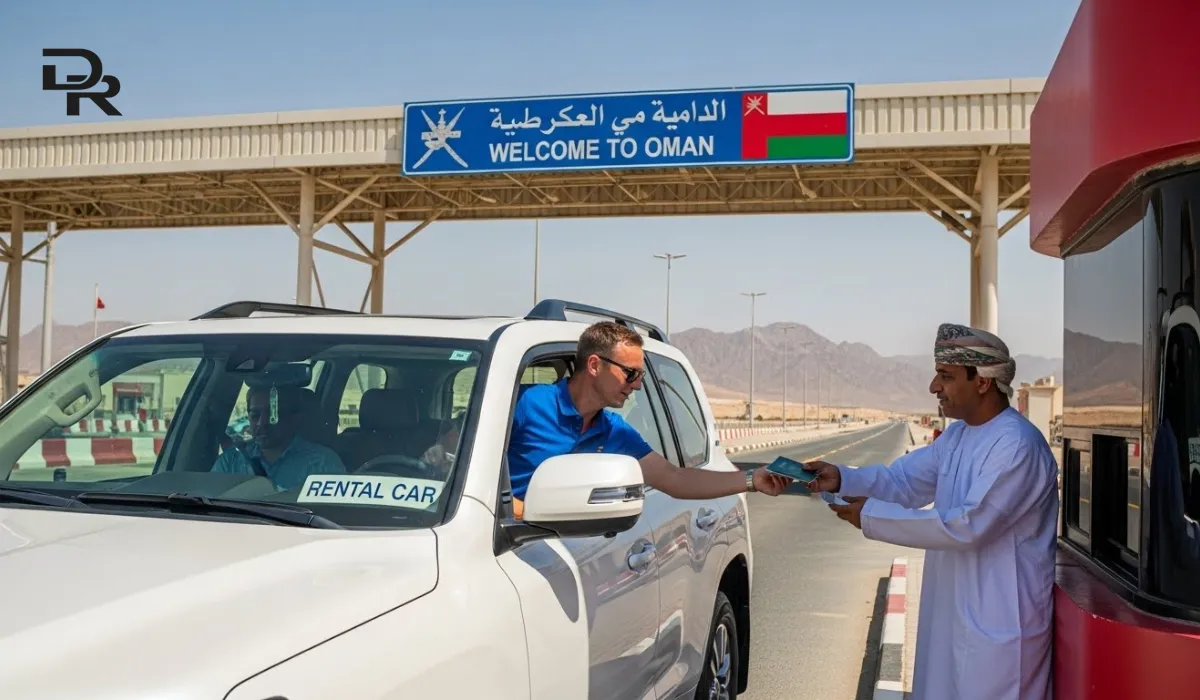
The first checkpoint is usually just before crossing from the UAE side. Here, border officials will check your passport, Emirates ID, and visa status.
They will often require you to pay an exit fee if you are a UAE resident. This is typically a small amount per person and can be paid by card at the exit point.
Officials will then check the vehicle documentation, Mulkiya and rental agreement, to ensure the car is legally permitted to leave the UAE. The NOC is verified to confirm that the rental company has authorized your travel abroad. If any document is missing, officials may deny exit.
After exiting the UAE, you will encounter the Oman border entry point. Here your passport and visa status will be checked. Oman has modern checkpoints where passports are stamped for entry.
GCC nationals often enter without a pre‑arranged visa, while others may receive a visa on arrival or present an eVisa if obtained in advance. Visa fees, generally around 5 Omani Rials, are paid at this entry point.
Vehicle documentation is then checked, including the Mulkiya, insurance (Orange Card), and NOC. Officials may also inspect the vehicle briefly.
Once all documents are verified and the fees are settled, you will receive an entry stamp for your passport and any necessary papers for the car.
The whole process, from UAE exit to Oman entry, can take anywhere from 45 minutes to over two hours depending on traffic and the efficiency of border staff, especially during peak travel times or holidays.
Several official crossings connect the UAE to Oman, but not all are equally suitable or permitted for rental cars. The most common and recommended ones for a Dubai to Oman driving trip are:
The Al Ain – Mezyad / Al Buraimi border crossing is often the preferred route for travellers heading to Muscat, Sohar, or southern Oman. It provides the most direct access from Dubai via highways and is well managed for international travel.
Other crossings such as Khatm al Shiklah (via Fujairah) may also be used for certain journeys, but rental company restrictions or routing rules sometimes limit which borders you can use, so always confirm your planned entry point with your rental agency.
Certain smaller crossings or those intended for local traffic may deny rental cars entry; this is especially true for borders near mountainous or restricted areas. It’s crucial to follow the border location specified by your rental company to avoid being turned back.
Standard UAE insurance does not cover driving in Oman. This means that even if your rental includes comprehensive insurance in the UAE, it may not be valid across the border.
Oman requires a separate insurance certificate (the Orange Card) that proves the vehicle is covered for at least third‑party liability while in Oman.
Renters must ensure that:
In some cases, short‑term insurance can be bought directly at the border crossing, but this usually covers only basic liability and not damage to your own vehicle.
Rental companies often arrange more comprehensive policies as part of the cross‑border package, which is more reliable for longer trips or more expensive cars.
Driving without valid Omani insurance will result in immediate denial of entry or fines, and at worst, may lead to the vehicle being impounded until proper coverage is obtained.
The best type of car for a Dubai to Oman road trip depends on your itinerary and comfort needs. For most travellers, a comfortable mid‑size sedan or SUV is ideal.
These vehicles offer good fuel economy for long highway stretches and sufficient space for luggage and passengers. If you plan to explore desert areas or mountainous regions such as Jebel Akhdar, a high‑clearance 4×4 SUV is recommended because some roads can be rough or unpaved.
Sports cars or low‑slung luxury vehicles are generally not recommended because they can struggle with uneven surfaces in rural areas, and some rental companies may prohibit them from crossing the border due to higher risk and insurance restrictions. Always confirm vehicle eligibility with your rental company before booking.
One of the most common mistake is assuming that a standard UAE rental car agreement automatically includes cross‑border permission. Without prior authorization and the necessary insurance, you can be turned back at the border.
Another frequent mistake is showing up at the border without the correct insurance coverage (Orange Card). Even if the rental company claims your UAE insurance “covers Gulf travel,” Oman’s rules are specific and often enforced strictly.
Failing to check visa requirements in advance can lead to delays if you are not eligible for visa‑on‑arrival or if your intended length of stay exceeds what the visa stamp allows. Overlooking small but mandatory fees, such as the UAE exit fee or Oman entry visa fee, can cause clearance delays.
Trying to cross through an unsupported border point is another mistake. Some crossings do not allow rental cars or require special certification, so follow the route your rental company has approved.
Yes, tourists can drive from Dubai to Oman in a rental car if the rental company allows it, and you have a valid passport, visa, UAE or international driving license, an NOC from the rental agency, the Mulkiya, and valid Oman insurance. These are standard requirements at the time of crossing and are strictly checked by border officials.
An International Driving Permit is not always strictly required if your license is in English or Arabic and recognized by both countries. However, it is strongly recommended for travellers whose licenses are in other languages or where translation may be an issue. Carry both your original license and IDP to avoid potential disputes at checkpoints.
Taking a luxury or sports car is often restricted by rental company policies. Many rental agencies prohibit high‑end or high‑performance vehicles from crossing the border due to insurance limitations and risk of damage. You must verify this with the rental company before booking.
Yes, Oman is generally safe for road trips. The country has a well‑developed road network with clear signage and strict traffic enforcement. Speed limits and road rules are actively monitored. However, in mountainous or remote areas, you need to drive cautiously, especially in changing weather conditions or on narrow roads. Always follow speed limits, obey traffic laws, and ensure your vehicle is suitable for the terrain you plan to explore.
The border crossing process typically takes 45 minutes to two hours, depending on the border post, the volume of traffic, and whether all documents are in order. Weekends, public holidays, and peak travel times can increase waiting times significantly.
Renting a car from Dubai to Oman is a rewarding way to explore both countries, but it requires meticulous preparation. Confirm in advance with your rental company that cross‑border travel is permitted, obtain the NOC, secure valid Oman insurance, ensure your driving license is accepted, and have all border documents ready.
Budget for insurance, fuel, visa and exit fees, and plan your route through the approved border crossing points. With proper planning and compliance, driving from Dubai to Oman provides flexibility, scenic routes, and the freedom to explore at your pace.
Also Read: How does Dubai have so many supercars?
.svg)